Frequently Asked Questions
Do Spencer trumpets come with a case?
Spencer trumpets are not supplied with a case. There are many excellent cases available, ranging from compact trumpet-shaped models to larger cases that can accommodate mutes and accessories. Choosing the right case is best done by the player, based on their individual needs.
Can I use any trumpet mouthpiece on a Spencer trumpet?
Machining on many inexpensive mouthpieces is variable and can result in an incorrect “gap” between the tip of the mouthpiece and the beginning of the leadpipe taper. Will generally recommends sizes equivalent to Bach 3, 5, 7 and 1/4C for all Spencer trumpets including the commercial model.
What is a venturi?
The venturi is the diameter of the tubing at the beginning of the leadpipe taper. Along with the mouthpiece gap and the position of the mouthpiece receiver brace, it can have a dramatic effect on the trumpet’s performance.
What difference does leadpipe material make?
Most manufacturers use brass leadpipes, which are increasingly prone to corrosion. To avoid this, Spencer trumpets use red brass, nickel, and silver leadpipes in a variety of thicknesses.
In general, brass is the most popular and produces a warm sound that can be easily coloured to suit most musical genres. Nickel is brighter and generally less suitable for classical repertoire and silver produces a very colourful and strident tone.
What is the difference between the 4, 5 & MV7 leadpipes?
The M/K 4 leadpipes are similar to the 43 leadpipes made by Vincent Bach, however Will has them manufactured from compressed nickel, giving them a brighter, more “jazzy” feel.
M/K 5 leadpipes are fitted to the Spencer Classic trumpets to give them an open feel with relatively relaxed slotting. It is based on the 25 leadpipes made and by Vincent Bach and similar to leadpipes found on most professional orchestral trumpets.
The M/K Mount Vernon 7 leadpipes were originally used on vintage Vincent Bach trumpets made in their Mount Vernon factory. When fitted to Spencer Trumpets, they make them easy to play, offer excellent slotting, and pair well with the standard bells.
Why does Spencer Trumpets use M/K products?
Will has had a professional and friendly relationship with Mike at M/K for over 15 years. M/K products are typically purchased by discerning players who already own professional instruments but want to improve them. The SR slides are especially popular; although they are not inexpensive, they play an important role in helping Will create instruments with exceptional evenness throughout the range.
Do Spencer trumpets use different bells for each model?
The standard bells on most Spencer Bb, C, and Eb trumpets are made from brasses containing different amounts of copper, commonly known as yellow brass, gold brass, red brass, and phosphor bronze. These bells are factory made but highly versatile, and by the careful matching and adjusting of other components Will is able to make them perform at least as well a bells costing several times the price.
The Classic model uses a much more expensive handmade seamed brass bell, which when combined with carefully selected components, sounds and feels similar to the sought after instruments made by Vincent Bach in the 1970s and 80s.
Why are Spencer trumpet slide braces so thick?
Brace positioning is crucial for both structural integrity and playability. As with many components in a Spencer trumpet, braces are positioned within fractions of a millimetre to achieve the desired tone, tuning and slotting characteristics. Thicker braces provide greater stability, and current models now feature threaded slide braces, allowing Will to achieve precise positioning and tension during assembly.
What are Saturn water keys?
Saturn water keys were designed by the renowned player and trumpet builder Denis Wedgwood in Wales, and are a genuine UK product.
They are typically found on instruments used in jazz settings but Will uses them because they are extremely simple to operate and maintain. To empty water, the player just needs to press the ring (of Saturn!) in any direction and Will particularly likes the fact that both the 3rd and main tuning slide water keys to be operated together with one hand without needing to stop playing!
Many players believe that lever-style water keys can improve a trumpet’s performance. In some cases this is true, as they introduce turbulence within the tuning slides. Turbulence is an important consideration in trumpet design, and since every Spencer trumpet is already designed with this in mind, additional turbulence is unnecessary.
What is a tone collar and why are they fitted to Spencer trumpets?
Tone Collars were originally designed for use on Spencer modular trumpets to aid slotting and create a denser, more focused sound. Since they are held on by the lower third valve cap, they can be easily removed, making the trumpet feel more agile with a more diffuse tone. For many years Tone Collars were distributed by Denis Wick and are still used by many players worldwide. Sadly they are no longer available from Denis Wick, but can be obtained from Will directly.
What is laser engraving?
Laser engraving uses a computer-controlled laser to accurately burn a design onto most materials. Spencer trumpets have always used this method, and because each trumpet is custom-built, personalised engraving can be requested.
Why does Spencer Trumpets use inexpensive Asian parts when boutique European valves are currently popular?
The first Spencer trumpets did use expensive valves made in Germany, but Will soon learnt that high cost and country of origin do not necessarily indicate superior quality.
In 2013, Will met the family-run Hoxon Gakki company from Taiwan, a centre of world-class manufacturing. He was impressed not only by the exceptional quality of their products, but also by their ethics, friendliness, and competitive pricing.
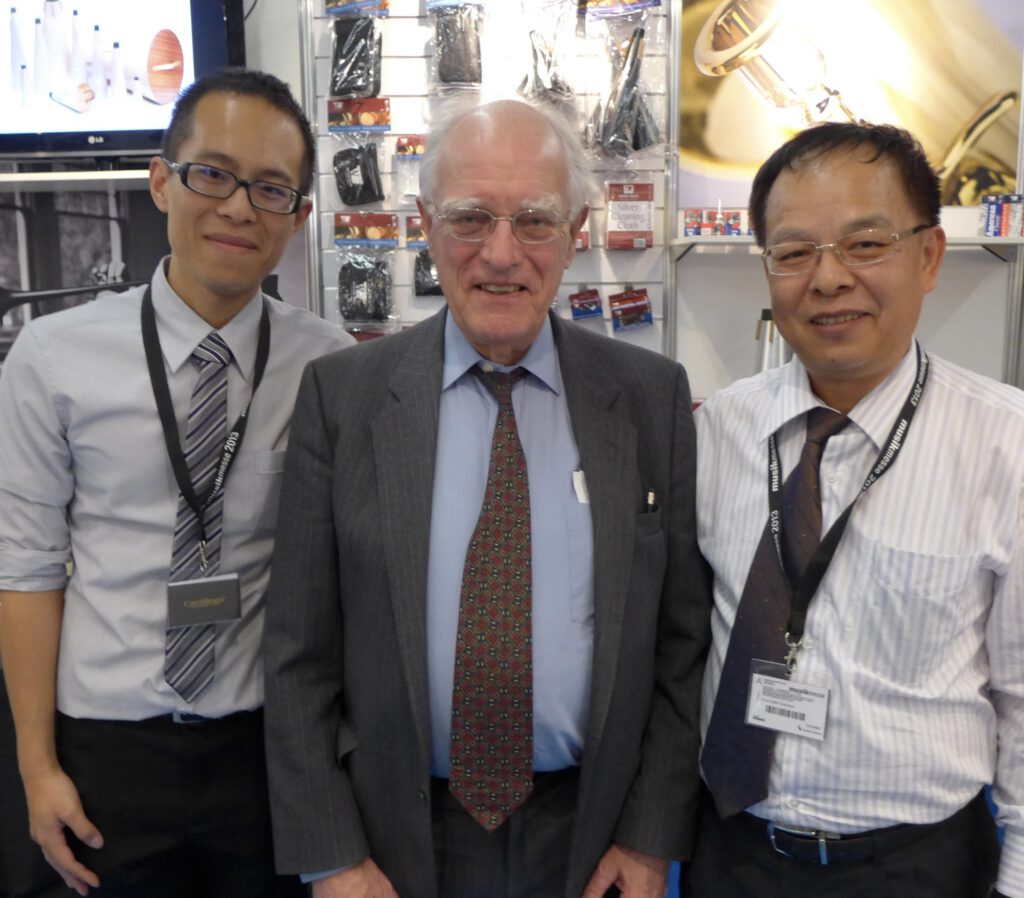
Kim and Wely Lee from Hoxon Gakki with Denis Wick
at Musikmesse 2014
Do Spencer trumpets play in tune?
All trumpets exhibit intonation deviation arising from the acoustical compromises of valved brass instruments. Unlike most production instruments, Spencer trumpets are individually play-tested by Will and repeatedly adjusted throughout the build process. These often microscopic changes, based on over 40 years of experience, optimise slotting consistency and response, resulting in stable intonation across the full range.
What is slotting?
Many instruments are designed so that pitch can be easily manipulated by the player’s embouchure. The amount of possible pitch variation on each note is known as the slot.
Some players describe an instrument as being “in tune” when in fact it simply has wide or relaxed slots. While this can work well for stronger players, it requires greater effort to maintain accurate tuning, particularly at extreme dynamics.
Spencer trumpets are built with tighter slots, meaning that once the centre of a note is found, it locks securely into place. This makes it easier to achieve consistent focus and accurate tuning without sacrificing tonal integrity, regardless of volume.
Does silver plating change the sound of the trumpet?
Silver plating is often described as making a trumpet sound brighter, but a more accurate description would be that it produces a more colourful and robust sound.
How do I look after my Spencer trumpet?
Like all trumpets, Spencer instruments require regular maintenance to ensure reliable, long-term performance.
Silver plate will tarnish—and can eventually fail—if not kept clean. Likewise, if dirt is allowed to build up inside the instrument, playing characteristics will deteriorate and valves may begin to fail.
Weekly cleaning of the leadpipe is strongly recommended, as this helps prevent dirt from circulating through the rest of the instrument. If dirt is found in the third valve, it is advisable to dismantle and clean the entire trumpet before performance is affected.
Many players lubricate valves and slides only once they begin to stick, but oils and greases not only improve action—they also protect the metal from oxidation. For this reason, daily oiling and regular slide greasing should be part of a normal routine.
There are many lubricants available, and players often have personal preferences. However, it is important to use high-quality products. Spencer’s Snake Oil is an excellent choice for valves and third valve slides, while Al Cass, Hetman, and Ultra-Pure oils are also popular. Will recommends Yamaha synthetic slide oil for first valve slides, and most high quality slide greases are suitable for main and second slides.
Will also manufactures his own food-safe slide grease, which is extremely long-lasting and unaffected by temperature.
What’s so special about Snake Oil?
Snake Oil is a petroleum-based valve oil containing ingredients similar to those found in many other valve oils, with the addition of granulated PTFE. Before being sold under the Denis Wick brand, it was tested by dozens of players, ranging from absolute beginners to top professionals, and quickly became a favourite among discerning musicians.
In 2025, Snake Oil regained its original branding and was reformulated using more environmentally sourced PTFE. Since then, it has become more popular than ever and is available from most specialist brass retailers.
Should I get my instrument ultrasonically cleaned?
Ultrasonic cleaning is now extremely common across many industries, and Will was one of the first brass repair technicians to use it. Many repair jobs can be very messy, and ultrasonic cleaning is often the most effective way to clean an instrument after major surgery. Will also uses this method when cleaning customers’ trumpets as part of a standard service.
The tank contains a unique enzyme solution that Will pioneered over ten years ago as an alternative to some of the unpleasant chemicals previously used in the brass instrument repair industry. Most brass instruments benefit from this form of cleaning; however, it can have a detrimental effect on the structural integrity of an instrument affected by red rot, sometimes resulting in holes. That said, in many cases the owner has been pleased that the hole appeared in the workshop rather than on stage!